In This Entry
Type-II Superlattice and Scale-Free Perception Matrix
1. Physical Introduction: Artificial Crystals Beyond Electromagnetic Limits
In breaking through the limits of traditional passive infrared detection, humanity introduced the Type-II Superlattice. This is an ultra-thin atomic layer structure formed by alternately stacking InAs and GaSb via Molecular Beam Epitaxy (MBE).
Unlike any natural material, its "band structure" is entirely artificially defined. Electrons and holes undergo forced probabilistic tunneling in staggered quantum wells, forming minibands. The effective bandgap of this material can be precisely tuned to near zero, allowing it to capture the faintest energy ripples in the universe.
2. M-Structure Virtual Particle Radar
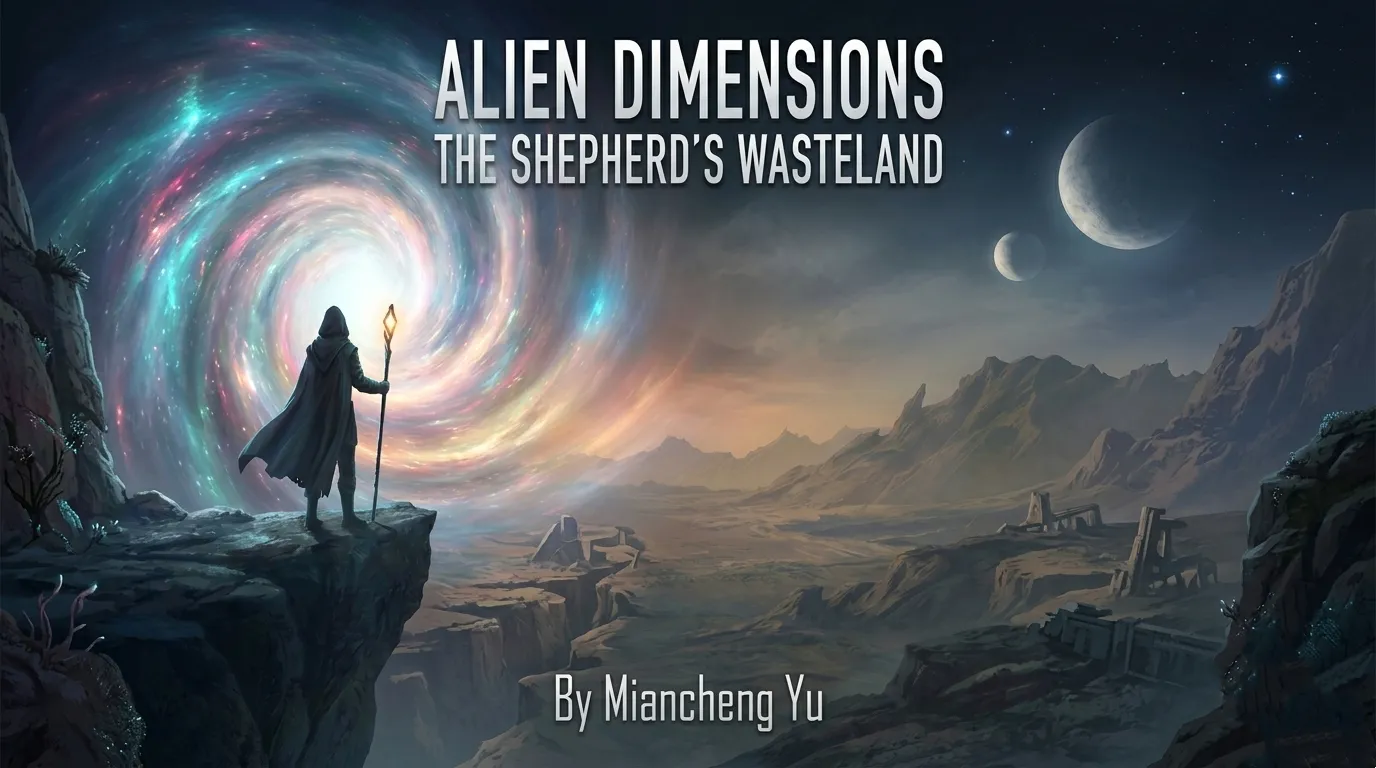
In the baryonic torsion confrontations of Shepherd's Wasteland, when the enemy attempts to conceal their physical entity using "topological compression armor" and "physical collision override," conventional electromagnetic radar becomes completely blind.
To pierce this cloaking barrier, the Computational Arena introduced the M-Type Virtual Particle Interferometric Radar.
Based on the principle of the real-world M-structure Superlattice: An artificial crystal of alternating semiconductor layers with a period larger than the natural lattice constant, creating mini-bands and enabling bandgap engineering.">superlattice, this radar inserts an extremely wide-bandgap barrier layer within the GaSb layer, creating a macroscopic band blockage. It no longer detects photons or infrared thermal radiation, but directly senses quantum vacuum fluctuations (miniband tunneling anomalies) caused by the presence of mass in space.
Even if the target conceals all electromagnetic signatures, the microscopic gravitational perturbation its mass exerts on spacetime triggers the tunneling collapse of effective electron mass within the Superlattice: An artificial crystal of alternating semiconductor layers with a period larger than the natural lattice constant, creating mini-bands and enabling bandgap engineering.">superlattice, achieving quantum perception efficiency exceeding 70% and realizing absolute physical stealth-breaking.
3. Auger Recombination Suppression and Anti-Logic Decay
At extremely low temperatures and in high-dimensional confrontations, "noise" is lethal.
In conventional materials, Auger Recombination causes detectors to generate severe dark current and data decay. However, within the Type-II Superlattice: An artificial crystal of alternating semiconductor layers with a period larger than the natural lattice constant, creating mini-bands and enabling bandgap engineering.">superlattice topology, by artificially creating a very large "electron effective mass," this non-radiative energy dissipation is physically suppressed.
In the context of Reality-as-Code, this "Auger suppression" mechanism is transformed into a physical-level firewall for the core hardware. It immunizes the perception matrix against logic crashes caused by "entropic noise" released by the enemy, ensuring the absolute stability of high-dimensional computation under extreme physical interference.
4. Conclusion: Scale-Free Horizon
By precisely controlling the periodic thickness of atomic epitaxy, the visual system of advanced entities achieves continuously adjustable perception from zero to the limiting energy level. Bunkers, walls, and even the repulsive fog of electron clouds—within the scale-free vision of the Type-II Superlattice: An artificial crystal of alternating semiconductor layers with a period larger than the natural lattice constant, creating mini-bands and enabling bandgap engineering.">superlattice—are all reduced to a naked cloud of tunneling quantum probabilities.
Further Reading (3 papers)
These real physics papers form the scientific foundation for this lore entry: